Re-innovation of the system of science and technology commissioners, cross-regional service to promote rural revitalization
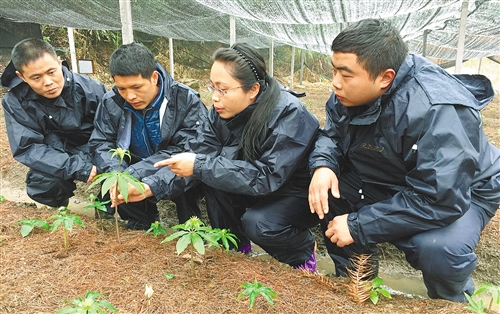
Su Hailan (second from right), a science and technology correspondent of Fujian Academy of Agricultural Sciences, is guiding farmers to plant seven leaves and one flower. (data picture)
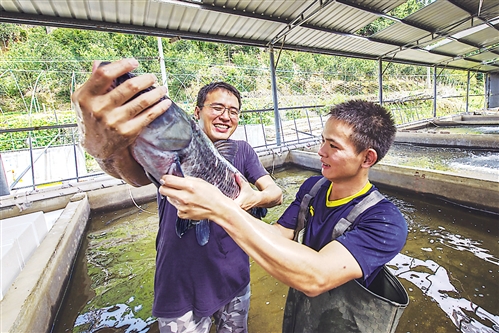
Xue Lingzhan (left), the science and technology correspondent of Fujian Freshwater Fisheries Research Institute, has been stationed in Shunchang Zhaoxing Fish Breeding Co., Ltd. for six consecutive years, and is responsible for the national large-scale freshwater fish industry technology system project and the research and development of freshwater famous and excellent economic fish. Zhu Yushe (Zhongjing Vision)
In the 1990s, Fujian Province began to provide scientific and technological services by sending scientific and technological commissioners to the village. After years of practice, the system of science and technology commissioners has not only promoted the upgrading and development of rural industries, but also expanded the service field, effectively promoted the development of the whole industrial chain of modern agriculture and became a good helper for farmers to increase their income and become rich. At present, Fujian’s science and technology correspondent system has been innovated again, which has achieved cross-regional and cross-sectoral talent selection, cross-regional service and radiation to the whole country, which has effectively promoted rural revitalization.
Seven-leaf and one-flower, mainly produced in Wuyishan area of Fujian Province, is a valuable Chinese herbal medicine and one of the main raw materials for more than 40 kinds of Chinese patent medicines such as Yunnan Baiyao and Pien Tze Huang. For a long time, due to the difficulty of artificial cultivation, we can only rely on the endangered wild resources, so the market price of Hedysarum crispus has risen and become one of the most sought-after Chinese herbal medicines in the market.
In 2014, a businessman in northern Fujian saw the business opportunity of planting and processing Chinese herbal medicines, and set up a company to plant seven leaves and one flower in Chongren Township, Guangze County, his hometown, and established a planting base. However, due to the weak scientific and technological foundation and lack of planting technology, the company’s seven-leaf and one-flower planting has encountered a "bottleneck". At this time, Su Hailan, who works in Fujian Academy of Agricultural Sciences, came to the company as a science and technology correspondent. With many years’ experience in planting Chinese herbal medicines such as Xiancao and Ophiopogon japonicus, Su Hailan quickly started with wild seedlings of Hedysarum septemloba, opened a 10-mu field laboratory, completed more than 200 cultivation tests and breeding tests in three years, screened out some maternal seedlings according to the results of previous tests in 2017, and further opened a 15-mu maternal garden for in-depth research, finally overcoming the artificial planting problem of Hedysarum septemloba. In the following four years, Su Hailan helped the local area to establish the technical regulations and traceability system for the cultivation and standardized cultivation of seven-leafed flowers, so that the seedling emergence rate of seven-leafed flowers increased from two years and only 5% to six months and exceeded 60%, and the base was expanded to 6,000 mu, which led the surrounding farmers to participate in planting extensively, with a scale of over 10,000 mu.
Develop rural industries
The system of special commissioners for science and technology originated from practice and originated in Fujian. Nanping, Fujian, in the 1990s, like most other places in China, the work concerning agriculture, countryside and farmers is faced with the dilemma of weak subject of scientific and technological innovation, insufficient investment in science and technology, weakened industrial competitiveness, lack of agricultural scientific and technological services, disconnection between scientific and technological talent resources and rural areas, agriculture and farmers, serious loss of rural factor resources and continuous decline in farmers’ income growth. Nanping city focused on the service of science and technology to solve the problems of agriculture, countryside and farmers, and first proposed the mode of dispatching "science and technology commissioners". In February, 1999, the city launched a pilot project of sending science and technology commissioners to serve in villages through government selection and two-way selection, and 225 science and technology personnel were sent to 215 villages to become the first batch of science and technology commissioners.
As the backbone of science and technology of Nanping Agriculture Bureau, Xie Fuxin is one of the first science and technology commissioners. At that time, his phone was called "Grape 110" by farmers, and he would be on call whenever he encountered planting problems; Wherever he went, the vineyard was built. During the dispatching period, Xie Fuxin trained more than 10,000 fruit farmers to promote the vigorous development of Nanping grape planting industry. Today, the city’s grape planting area is 63,000 mu, with an annual output value of more than 600 million yuan. The villagers who benefited all called Xie Fuxin a "grape fairy". After that, Zhan Yisheng, Gao Yunwang, tea fairy, Liu Guoying, Mi Wen-qing and Zhu Zhen-qing also appeared in Nanping, all of whom were technicians who set up an industry and made a breakthrough in agriculture, countryside and farmers. Since then, in the vast land of northern Fujian, from fields to mountain woodlands to enterprise bases, a number of star science and technology commissioners have emerged, becoming the "God of Wealth" in the eyes of farmers.
In 2002, the on-the-spot meeting of the national science and technology correspondent was held in Nanping City, and Nanping’s experience was promoted to the whole country. In 2016, the General Office of the State Council issued "Several Opinions on Deepening the System of Science and Technology Commissioners" and the Fujian Provincial Government issued "Implementation Opinions on Deepening the System of Science and Technology Commissioners" to promote the sustainable development of the system of science and technology commissioners from a higher level and in a wider field.
Expand the service field
With the passage of time, great changes have taken place in agricultural production mode, which has gradually developed from a single traditional production to industrialization, standardization and branding. With the new situation, Fujian’s science and technology Commissioner system, which has been continuously explored, has begun to extend from the traditional agricultural field to emerging industries, expand across borders, and carry out entrepreneurial services in all links of the industrial chain.
In Fuqing City, a city with large marine resources, Chen Bilian, a science and technology correspondent of Fujian Province and a professor of Fujian Normal University, led a team to dock with the leading domestic enterprise, New osawa Spirulina Co., Ltd., stationed in the front line of production and technology research and development for a long time, and jointly undertaken more than 10 national and provincial major scientific research projects. In the past three years, driven by the project, the two sides have jointly built a production line with an annual output of 20 tons of phycocyanin, with increased sales of more than 900 million yuan, and related achievements won the second prize of Fujian Science and Technology Progress in 2017.
At present, Fujian has built 13 entrepreneurial industrial chains of national and provincial science and technology commissioners such as edible fungi, bamboo processing, white feather and semi-muscovy duck, more than 40 national-level star-studded worlds, more than 750 enterprises, entrepreneurial bases and economic cooperation organizations, and cultivated more than 20 local brands such as "the hometown of Castanea henryi in China" and "the hometown of bamboo in China", which has effectively promoted the value-added and brand development of the whole industrial chain of modern agriculture.
In this regard, Li Jianyi, director of the Rural Science and Technology Department of the Fujian Provincial Department of Science and Technology, believes that the current process of rural urbanization is accelerating and the integration of the primary, secondary and tertiary industries is accelerating. In this context, Fujian not only selects and recognizes scientific and technological talents in the agricultural field, but also actively sends a group of scientific and technological personnel in the fields of industry and social development to serve rural entrepreneurship, making efforts to expand leading industries in the county and accelerate the modernization of agriculture and rural areas.
Achieve cross-border services
Nowadays, not only the service field has been expanded, but also the team of science and technology commissioners has become increasingly integrated and cross-regional. Looking through the list of science and technology commissioners in Fujian Province, we can see that these scientific and technological talents who are active in the front line of agriculture and rural areas include both provincial experts and "permanent brand" local experts who are familiar with local conditions, as well as foreign experts. Behind them, there are teams from Chinese Academy of Sciences, Peking University, Tsinghua University and Nanjing Forestry University, and their service areas have expanded from this province to other provinces and even overseas. This is a great initiative for Fujian to explore the new cross-border service of science and technology commissioners, broaden the channels for the selection and recognition of science and technology commissioners, and take the lead in selecting talents across sectors and regions in the country. The selection targets are expanded from the province to outside the province and even overseas, regardless of sources, service areas or service areas. Pucheng county science and technology market workstation has become the first national expert service base in the province by introducing more than 600 science and technology commissioners from more than 20 universities, institutes and science and technology service intermediaries. In Fujian Ninghua Minfu Fruit and Vegetable Professional Cooperative, Zhang Xu, from Jiading District Agricultural Technology Extension Service Center, who is engaged in the research and promotion of watermelon, provided services to the cooperative across provinces with the help of the mechanism of science and technology commissioners. He systematically carried out the application and popularization of soil improvement technology and fruit cracking prevention technology in Hami melon greenhouse, which improved the planting level of Hami melon in cooperatives.
"This is another innovative measure of the Fujian Science and Technology Commissioner system." Chen Qiuli, director of the Science and Technology Department of Fujian Province, said: in view of the actual needs of rural revitalization and development in the new era, on the basis of selecting and recognizing the special commissioners for science and technology in the province, we will strive to attract a group of scientific and technological personnel with high technical level from universities and institutes outside the province who can solve practical problems to innovate and start businesses at the grassroots level in Fujian to lead and drive rural revitalization.
Xue Qiang, deputy director of Nanping Science and Technology Bureau, said that in the past 20 years, there have been 10 batches of 9,365 science and technology commissioners in Nanping who went to the rural front line, achieving full coverage of 1,634 administrative villages. The contribution rate of science and technology to agricultural growth in the city has increased from 33% in 1999 to 63% in 2017. Since 1999, the total output value of agriculture, forestry, animal husbandry and fishery in the city has increased by 10.3% annually, and the per capita net income of farmers has increased by 9.9% annually. At present, the system of science and technology commissioners has spread all over the country. Fujian Province alone has sent 16,300 science and technology commissioners, with a township coverage rate of 93.8%, covering 10 characteristic agricultural industries and extending to the secondary and tertiary industries.
Economic Daily China Economic Net reporter Chen Yu