The latest GDP of 29 provinces is released! Henan ranked fifth for 17 years in a row, and Su Chao in Guangdong was 10 trillion yuan.
[Dahe Daily Dahe Finance Cube] (Reporter Xin Huang Chen Yuxi)In the extraordinary year of 2020, China handed over a bright "report card" to the world. China’s gross domestic product is 101,598.6 billion yuan, exceeding the 100 trillion yuan mark for the first time.
Behind the GDP of over 100 billion, what is the development of each province?
"Guangdong Boss" and "Su Daqiang" have a GDP of over 10 trillion yuan.
According to the statistics of Dahebao Dahe Finance Cube reporter, as of January 26th, except Hebei and Xinjiang, 29 provinces (excluding Hong Kong, Macao and Taiwan) have published GDP data.
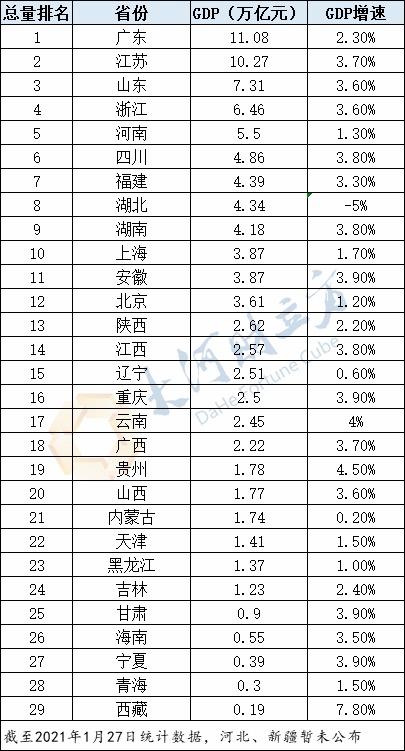
In terms of the total amount, Guangdong Province led again with 11.08 trillion yuan, ranking first in the country for 32 consecutive years.
How strong is China’s largest economic province? It is reported that the economy has surpassed more than 90% countries in the world, comparable to Canada, Russia and South Korea, and far exceeds Spain, Australia, the Netherlands and other countries.
It is worth noting that in 2020, Guangdong’s local general public budget revenue was 1,292.2 billion yuan, making it the only province in China that exceeded one trillion yuan.
Followed by "Guangdong boss" is Jiangsu Province.
The total GDP of "Su Daqiang" in 2020 also exceeded 10 trillion yuan, reaching 1.027 billion yuan. This is also the first time that Jiangsu’s GDP has passed the threshold of 10 trillion yuan. Although there is still a gap between the total GDP and Guangdong Province, the per capita GDP of Jiangsu Province is 125,000 yuan, ranking first among all provinces in China.
As the only two provinces with GDP exceeding 10 trillion in China, in 2020, the added value of the tertiary industry in Guangdong Province accounted for 56.5%, and that of the tertiary industry in Jiangsu Province accounted for 52.5%, both exceeding 50%. In terms of scientific and technological innovation, both Guangdong and Jiangsu provinces have greatly increased their investment in scientific research. In 2020, the proportion of social R&D investment in GDP in Guangdong Province will increase from 2.4% to 2.9%, while that in Jiangsu Province will reach 2.82%.
Other provinces with GDP exceeding 5 trillion include Shandong Province (7.31 trillion yuan), Zhejiang Province (6.46 trillion yuan) and Henan Province (5.5 trillion yuan).
In addition, Sichuan, Fujian, Hubei and Hunan provinces are "4 trillion+"provinces, while Shanghai, Anhui and Beijing are "3 trillion+"provinces. At present, the accumulated GDP of 24 provinces has exceeded one trillion. The GDP of Hebei and Xinjiang in 2020 has not been announced yet. In 2019, the GDP of Hebei Province was 3,510.45 billion yuan, ranking 13th in the country. Xinjiang Autonomous Region is 1,359.711 billion yuan, ranking 25th in the country.
Compared with last year, the top ten GDP this year has remained basically unchanged. Only Fujian Province overtook Hubei and rose to the seventh place. However, affected by the epidemic, Hubei’s annual GDP fell by 5.0%, and its ranking slipped to the eighth place.
Geographically, the northern provinces of Zhongshan East Province and Henan Province are among the top ten in GDP. Five years ago, Shandong, Henan, Hebei and Liaoning were the top ten provinces in GDP in 2015, and the strength of the north and the south was roughly equal. In recent years, Fujian, Hunan and other southern provinces have risen rapidly. Among them, Fujian’s GDP ranking increased from 11 in 2015 to 7 in 2020, and rose by 4 places in just five years.
The GDP growth rate of southeast coastal provinces slowed down as a whole
In 2020, the domestic and international economy as a whole is facing greater downward pressure, but China’s economy is improving steadily, and it still maintains a good positive growth.
According to the data released by the National Bureau of Statistics, in 2020, China’s GDP will increase by 2.3% compared with the previous year at comparable prices.
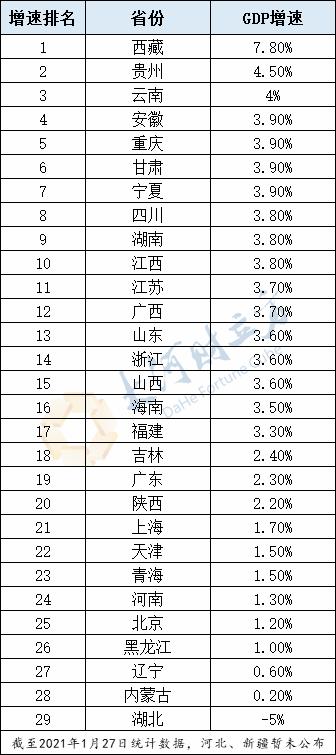
Among them, Xizang leads the country with a growth rate of 7.8%, which is 3.3 percentage points higher than the second place in Guizhou Province. It is worth noting that the per capita disposable income of urban and rural residents in Xizang increased by 10% and 12.7% respectively, and the growth rate was also among the highest in China.
The provinces with GDP growth rate higher than 4% are Guizhou and Yunnan, which are 4.5% and 4% respectively, ranking second and third in the country.
In 2020, the GDP growth rate of Henan is 1.3%, which is higher than that of Beijing (1.2%) and Heilongjiang (1%).
Up to now, a total of 18 provinces have outperformed the national average in GDP growth, 1 province (Guangdong Province) is equal to the national average, and 10 provinces are lower than the national average.
Hubei province, which was most affected by the epidemic, became the only province with a negative GDP growth rate.
Calculated at comparable prices, the GDP of Hubei Province will decrease by 5.0% in 2020 compared with the previous year. However, it is worth noting that, compared with the first quarter of 2020, the decline in the annual GDP growth rate in Hubei Province narrowed by 34.2 percentage points, and the economy showed a strong recovery trend.
It is worth noting that, geographically, the GDP growth rate of southeast coastal provinces has shown a slowdown to some extent.
In the TOP10 GDP growth rate, there are no southeast coastal provinces on the list. Jiangsu Province, with the highest growth rate, has a GDP growth rate of 3.7%, ranking 11th in the country. The GDP growth rate of Guangdong, the largest province in China, was 2.3%, which was the same as the national average. Shanghai’s GDP growth rate is 1.70%, even lower than the national average.
Among the three northeastern provinces, Jilin’s GDP growth rate is 2.4%, slightly higher than the national average (2.3%), while Heilongjiang’s and Liaoning’s GDP growth rates are 1.00% and 0.60% respectively, both lower than the national average.
There are many bright spots in the GDP of each province.
Henan’s GDP has ranked fifth in the country for 17 consecutive years.
Through the analysis of GDP data of various provinces in China, the reporter found that all provinces have bright spots.
In terms of scientific and technological innovation, Guangdong’s R&D expenditure increased from 180 billion yuan to 320 billion yuan, accounting for 2.4% of the regional GDP, and the number of effective invention patents and PCT international patent applications remained the first in the country. The proportion of R&D expenditure in Jiangsu Province reached 2.82%.
Guangdong has implemented the "Guangdong Strong Core" campaign in depth, and accelerated the filling of shortcomings in the fields of integrated circuits, industrial software and high-end equipment. Accurately implement the provincial R&D plan in key areas, major basic research projects, and the Guangdong, Hong Kong and Macao joint funding plan for scientific and technological innovation, aiming at frontier areas such as artificial intelligence, blockchain, quantum technology, life and health, and seed science to strengthen research and development and accelerate the cultivation of future industries.
In terms of industry, in 2020, the added value of industrial enterprises above designated size in Guangdong Province was 3.31 trillion yuan, a year-on-year increase of 1.5%, still ranking first in the country. At present, Guangdong province has formed a pillar industry with information technology, advanced manufacturing, automobile manufacturing, smart home appliances, advanced materials and biomedicine as the mainstay.
In terms of foreign trade, in 2020, the total import and export volume of goods in Guangdong Province was 7.1 trillion yuan, accounting for 22% of the national total (32.16 trillion yuan), ranking first in the country for many years.
In terms of capital market, the total transaction volume of Shanghai’s financial market reached 2,274.8 trillion yuan, up by 17.6%. There were 51 regional headquarters of multinational corporations, 20 foreign-funded R&D centers, and a number of high-level scientific research institutions such as national laboratories and Qizhi Research Institute settled down. The construction of "five centers" in Shanghai has achieved major goals, the international economic, financial, trade and shipping centers have been basically completed, and the scientific and technological innovation centers with global influence have formed a basic framework.
In terms of agriculture, in 2020, Henan’s total grain output exceeded 130 billion Jin for the fourth consecutive year, and for the first time it crossed the 135 billion Jin step, reaching 136.516 billion Jin; The sown area of grain crops in Guangdong Province increased by 661,000 mu over the previous year, and the total grain output reached 12,675,600 tons, a record high since 2013, with a year-on-year increase of 2.2%.
As far as Henan is concerned, in 1949, the GDP of Henan Province was only 2.088 billion yuan, the per capita GDP was only 50 yuan, the total grain output was only 14.27 billion Jin, and the added value of the tertiary industry was only 295 million yuan. In the past five years, the GDP of Henan Province has successively reached two big steps of 4 trillion yuan and 5 trillion yuan, and the per capita GDP has exceeded 8,000 US dollars. The total fiscal revenue exceeded 620 billion yuan, and the general public budget expenditure exceeded 1 trillion yuan. The balance of deposits and loans of financial institutions exceeded 7 trillion yuan and 6 trillion yuan respectively.
In 2020, the GDP of Henan Province reached 5,499.707 billion yuan, ranking fifth in the country for 17 consecutive years since 2004.
Zhang Zhancang, counselor of Henan provincial government and former president of Henan Academy of Social Sciences, said in an interview with Dahebao Dahe Finance Cube that the task of industrial structure transformation and upgrading in Henan province is arduous, and there are obvious shortcomings in high-quality development. In the future, we need to do our own thing in a down-to-earth manner to ensure the stability of the country’s status as the fifth largest economic province.
GDP growth targets of many provinces in 2021
Set it above 6%
According to incomplete statistics, the GDP growth target of many provinces in China in 2021 is set at above 6%.
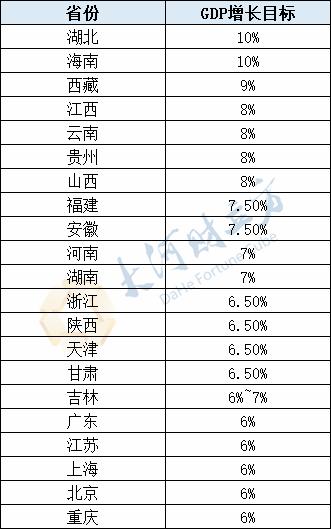
Among them, Hubei and Hainan put forward GDP growth targets of more than 10%; The GDP growth targets of Xizang, Jiangxi, Yunnan, Guizhou and Shanxi are all above 8%.
Among the central provinces, the economic growth targets of Henan, Hunan, Shanxi and Anhui are 7%~8%.
The GDP growth targets of relatively developed regions, such as Beijing, Shanghai and Guangdong, are all around 6%.
According to the work report of Henan provincial government, the main expected goals of Henan’s economic and social development in 2021 are: GDP will increase by more than 7%, the added value of industrial enterprises above designated size will increase by about 7%, investment in fixed assets will increase by 6%, the total retail sales of social consumer goods will increase by 9%, the consumer price will increase by about 3%, the general public budget revenue will increase by 5%, the income of residents will increase steadily, and the urbanization rate of permanent residents will increase by about 1.3 percentage points. The energy consumption per 10,000 yuan GDP decreased by about 3%, the total value of imports and exports increased steadily, 1.1 million new jobs were created in cities and towns, the urban unemployment rate was controlled at about 5.5%, and the grain output remained above 130 billion Jin.
Zhang Zhancang said that Henan’s GDP should be set above 7% in 2021, which should be realized hopefully. Because of the epidemic in 2020, Henan’s GDP growth rate is low. It will increase by more than 7% on the basis of 2020, which has a relatively sufficient basis.
Dr. Bai Jiangtao, a scholar at Shanghai Maritime University, said in an interview with Dahe Daily and Dahe Finance Cube that Henan’s GDP growth forecast this year is highly reasonable. Thanks to the continuous and smooth progress of the reform of separation of powers, the efficiency of agricultural production capacity, which plays a fundamental role in Henan’s industrial structure, has improved. At the same time, Henan Province has the advantage of the transportation hub of the Eurasian Continental Bridge in the central part. With the development of international cross-border logistics, the economy of Henan Province will also create incremental contributions.
Due to greater uncertainty, the country has not set an economic growth target in 2020.
In this regard, Ma Jun, member of the Monetary Policy Committee of the People’s Bank of China and director of the Tsinghua University Financial and Development Research Center, publicly stated at the symposium on "Interpretation of the Central Economic Work Conference and Analysis of the Current Economic Situation" held recently that starting from this year, the GDP growth target should be permanently cancelled, while stabilizing employment and controlling inflation should be the main objectives of macroeconomic policies. The figure of GDP can be used as a forecast, the financial department can use it as a basis to predict fiscal revenue and expenditure, and the investment department can use it as a basis to predict investment behavior, but it should not be used as an index to assess the performance of local government officials.
Editor: Chen Yuyao | Audit: Li Zhen | Director: Wan Junwei

Reporting/feedback